




Do your plates still have bits of food on them after a wash? Is there dirty water sitting at the bottom of the tub? Does the inside of your dishwasher smell bad? A blocked filter is one of the most common causes, and it is easy to fix at home.
This guide explains what the filter does, how to tell when it needs cleaning and how to clean it safely, step by step.
Switch the dishwasher off at the wall, remove the bottom rack, twist and lift out the filter, rinse the parts under warm running water and gently scrub them with a soft brush and washing-up liquid. Clear any debris from the sump, then refit the filter and lock it into place. Do this about once a month, or weekly if you use the dishwasher every day.
What Does a Dishwasher Filter Do?
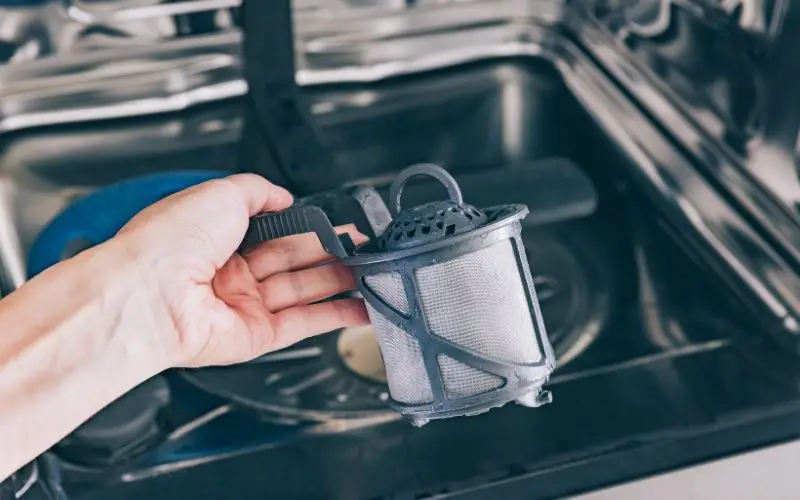
The filter sits at the bottom of the dishwasher tub, under the lower spray arm. It catches food scraps, such as rice, seeds and bones, and it stops grease, paper labels and bits of glass from reaching the drain pump. It also keeps the wash water cleaner, so your dishes come out cleaner.
Most modern dishwashers have a manual filter, which means you need to take it out and clean it by hand. When the filter fills up, water cannot pass through properly. Dirty water can spray back onto your plates, and the drain pump has to work harder, which can shorten its life.
Signs the Filter Needs Cleaning
Look out for these signs. Dishes feel gritty or look cloudy after a cycle. Water stays at the bottom of the tub when the cycle finishes. There is a bad smell when you open the door. You hear a loud humming when the machine tries to drain. An error code appears on the display. Error codes vary by brand and model, so check your manual to see what yours means.
How to Clean a Dishwasher Filter
Step 1: Turn off the power. Safety comes first. Switch the dishwasher off at the wall socket and unplug it. Never open electrical panels, because water and electricity are dangerous together. Contact a professional for any electrical work.
Step 2: Remove the bottom rack. Pull the door fully open, and slide out the lower rack. Place it on the floor or the worktop, out of the way.
Step 3: Take out the filter. Look at the bottom of the tub. You will see a round, plastic filter, usually in the centre. Most filters twist anticlockwise by a quarter turn and lift straight out, but check your manual, because designs differ. Underneath, there may be a flat mesh plate, which also lifts out.
Step 4: Wash the filter. Take the parts to the sink. If the fine mesh separates from the plastic frame, separate them. Rinse everything under warm running water, and scrub gently with a soft brush or old toothbrush and a little washing-up liquid. Do not use wire wool or hard scrapers, because they can damage the fine mesh. For limescale, soak the parts in a mix of warm water and white vinegar for 15 to 20 minutes, if your manual allows it, then rinse well.
Step 5: Clear the sump. Look into the open hole at the bottom of the tub. Mop up any dirty water with a cloth, and pick out loose seeds, paper labels or pieces of glass. Wear gloves, because broken glass can be sharp. Check that nothing is blocking the drain pump area, but do not push tools into it.
Step 6: Refit and lock the filter. Put the flat plate back first, then the round filter, and twist it clockwise until it locks, often with a click. It must sit flat and fully locked, because a loose filter lets food reach the pump. Replace the rack, and run a short rinse to check that the dishwasher drains properly.
Hard Water and Filter Care in London
London water is very hard, and limescale can build up on the filter mesh, mixing with grease to form a hard crust. To reduce it, use dishwasher salt if your machine has a salt container, and top it up when the indicator light comes on. Run a hot wash with a dishwasher cleaner or descaler about once a month, following the instructions on the pack. Clean the filter regularly, so that scale and grease do not build up. If the mesh is badly damaged or clogged with scale that will not come off, ask the manufacturer or an engineer about a replacement.
When a Clean Filter Does Not Fix the Problem
Most drain problems are solved by cleaning the filter. But if water stays in the tub after you have cleaned it, something deeper could be wrong, such as a blocked drain hose, a faulty drain pump or a blocked air gap. Our guide on why your dishwasher is leaving water at the bottom explains the common causes.
Call an engineer if water remains in the machine after a complete cycle, if you hear a loud grinding noise from the drain pump, if water leaks onto your kitchen floor, if the machine trips your fuse box or if an error code stays on the screen after cleaning. An engineer will check the drain pump, test the waste hose and replace faulty parts safely.
Frequently Asked Questions
How often should I clean the dishwasher filter?
About once a month is a good guide. If you use the dishwasher every day, or you often wash greasy dishes, clean it once a week. Scrape food from plates before loading, because it helps keep the filter clean.
Can I run the dishwasher without the filter?
No. Without a filter, food and debris can reach the drain pump and damage it, and it can block the pipes.
Can I clean the filter in the dishwasher?
It is best to wash it by hand. Most manufacturers recommend hand washing, and the dishwasher may not remove grease from the fine mesh.
Why does my dishwasher still smell after I clean the filter?
Smells can also build up in the rubber door seal, the spray arm holes and the drain hose. Clean the seal and the spray arm jets, and run a hot wash with a dishwasher cleaner.
How often should the filter be replaced?
Filters do not usually need replacing often. Clean them regularly, and replace them only if they are damaged or the mesh is worn. Check your manual for the right part.
Need Help With a Blocked or Leaking Dishwasher?
If your dishwasher is not cleaning, not draining or showing error codes even after you have cleaned the filter, do not let it spoil your kitchen routine. Our trained and insured engineers cover all London boroughs, and we carry parts for Bosch, Beko, Samsung, Hotpoint, Indesit, LG and Siemens dishwashers, with a guarantee on parts and labour. We repair drain pumps, water valves, spray arms and control boards.
If the filter clean has not solved the problem, book a visit for Dishwasher Repair in London and get honest advice and clear pricing. Contact London Appliance Repair now.